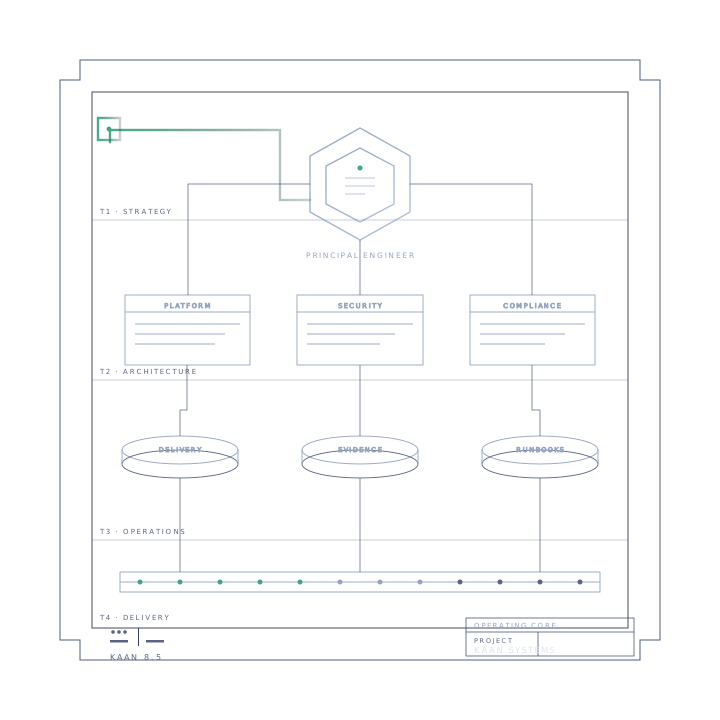
Discovery before commitment.
Every engagement starts with structured discovery — short, scoped, and written. Nothing larger is committed to until the problem and the path are legible to both sides.
Kaan Systems exists to bring engineering discipline to organizations that depend on infrastructure but were never built around it. The output is durable: systems your team can operate, evidence auditors can verify, and architectures that survive the next decade of change.
We measure success by whether the systems we leave behind hold their shape under change — new teams, new auditors, new regulations, new product directions. The goal is not a deliverable. The goal is durable operational capability.
These are not aspirational. They're the constraints we actually impose on our work, in the order we apply them.
We treat infrastructure as a system to be designed — with explicit interfaces, observable behavior, and properties that hold under change. The work outlives the engagement because the model behind it does.
Manual operational work is debt. We default to expressing intent as code, generating evidence from running systems, and reserving human attention for decisions that genuinely require it.
Security postures are designed alongside the systems they protect — identity, data, network, and supply-chain controls expressed as platform properties rather than late-stage overlays.
Regulatory constraints inform architecture from the first whiteboard. The result: control evidence emerges from the system itself, instead of being reconstructed under audit pressure.
Engagements are anchored by senior engineering leadership — direct authorship on architecture, hiring shape, and operational maturity. No layers between decision and delivery.
The delivery practices that turn architecture into durable operating capability.
Every engagement starts with structured discovery — short, scoped, and written. Nothing larger is committed to until the problem and the path are legible to both sides.
Senior engineering leadership writes the architecture and the operating model. We do not subcontract the thinking layer of the work.
Every engagement is designed for the day after we leave. Runbooks, evidence pipelines, and operational knowledge transfer are first-class outputs, not afterthoughts.
We deliberately operate with a small number of concurrent engagements. The constraint is not bandwidth — it's the cognitive load required to do regulated infrastructure work well.
Kaan Systems engagements are anchored by senior engineering leadership with operating experience across the environments our clients actually run in.
Kaan Systems is structured for durability — recurring service models, productized delivery, and emerging proprietary technology developed inside Kaan Labs.
Continuity contracts that turn one-time architecture work into operating relationships.
Delivery practices designed for environments where change control, audit trails, and SLO posture are non-negotiable.
Repeatable engagement shapes that compress discovery time and produce predictable outcomes.
An internal R&D function that develops platform concepts the market is moving toward.
Deep emphasis on healthcare-adjacent regulated workloads — where rigor compounds into durable advantage.
If your organization is weighing an infrastructure decision where the cost of being wrong is real, we should talk.
Open a conversation →