The patterns we'd hand you on day one.
Short, single-page guides to the operating work that quietly determines whether a regulated cloud environment scales — HIPAA postures, drift detection, evidence pipelines, security questionnaires, threat models. Every entry ends with a free template you can copy into your own repository. No email gate.
-
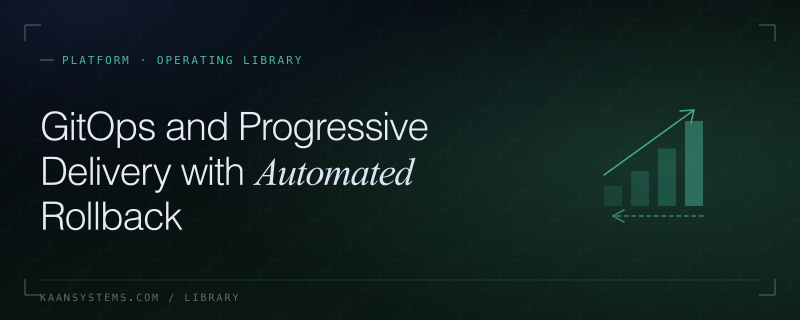
Platform GitOps and Progressive Delivery with Automated Rollback
CI pipelines that kubectl apply into production fail quietly: drift, rollback archaeology, cluster credentials living in your most-attacked system. A pull-based GitOps controller plus SLO-gated canaries fixes all three. The git history it produces is change-management evidence your auditor will accept without a single screenshot.
-
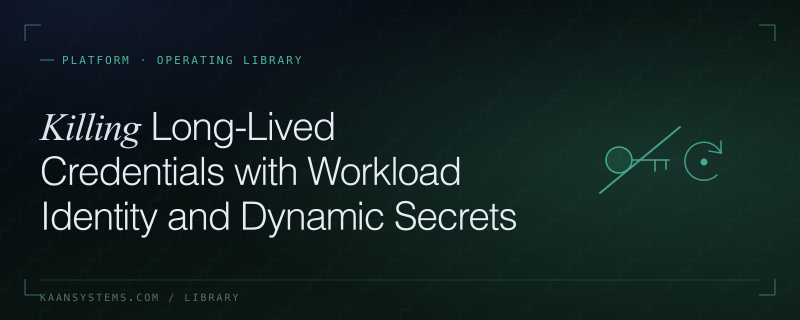
Platform Killing Long-Lived Credentials with Workload Identity and Dynamic Secrets
Static credentials are the breach vector that actually gets used: they work until someone revokes them, and nobody revokes them. A phased plan for replacing IAM user keys, CI secrets, and database passwords with workload identity, OIDC federation, and dynamic secrets, with the static-credential count as the program KPI.
-
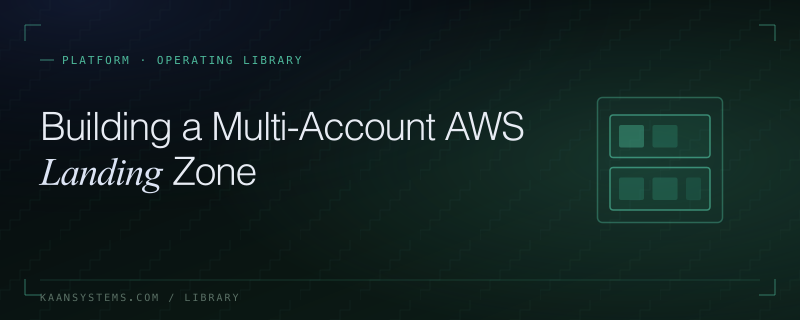
Platform Building a Multi-Account AWS Landing Zone
One AWS account with tag-based separation concentrates blast radius and fails audits. A landing zone design for 10-80 engineer teams: OU topology, service control policies, identity, networking restraint, and the Control Tower decision, with a reference template.
-
Engineering Practice On-Call Without Burning Out the Team
On-call is where reliability and retention collide. Done badly it burns out your best engineer and trains everyone to ignore alerts. Four levers — a real rotation, alert quality, a severity ladder, and recovery — make it sustainable.
-
Security Vendor Risk Scoring for Regulated SMBs
A vendor breach becomes your breach. Most SMBs 'assess vendors' with a gut check at procurement and never again. A lightweight four-factor rubric produces a repeatable risk score, sorts vendors into tiers, and sets a review cadence that matches the risk.
-
AI What Enterprise Buyers Actually Ask About Your AI Features
As you add AI features, enterprise security questionnaires grow an AI section. Buyers aren't testing whether your AI is flawless — they're testing whether you've thought about the AI-specific risks. Five themes, four answer patterns, fifteen pre-filled responses.
-
Compliance The 90-Day SOC 2 Readiness Sprint
Choosing SOC 2 is the easy part. The next question — what's the actual plan to get there — is where teams stall for a year. Here is the 90-day version: scope, policy, controls, evidence, in that order.
-
AI Adding AI Features Without Breaking Your Compliance Posture
Every healthcare-adjacent SaaS is racing to add AI features. Most haven't traced what that does to their HIPAA or SOC 2 posture. Four leak points, one pre-flight checklist, no surprises at the next audit.
-
Security Zero-Trust for Regulated SMBs Without the Enterprise Price Tag
Zero-trust is marketed as an enterprise platform you buy. The principle — never trust, always verify — is achievable for a regulated SMB with identity tools you likely already have. Four phases, sequenced, with an honest 'good enough' bar at each.
-
FinOps The 30-Day Cloud Cost Cleanup
Cloud bills compound. By year two of any AWS account, 20-40% of the monthly spend is on resources nobody remembers naming. A structured 30-day cleanup pulls it back without touching application code.
-
Compliance Choosing Between SOC 2, HITRUST, and HIPAA Attestation
SOC 2, HITRUST, and HIPAA all sound like they certify 'security,' but they signal different things to different buyers. The decision framework for which one to pursue when.
-
Compliance Evidence Pipelines 101: How to Stop Reconstructing Audit Artifacts Quarterly
Most teams reconstruct audit evidence from scratch every quarter. That's weeks of senior engineering time spent producing artifacts a running system could generate itself. The pipeline below does it automatically.
-
Platform Detecting Infrastructure Drift Without Drowning in Alerts
Drift detection at scale produces thousands of 'differences,' most of them noise. A tiered classifier routes the dangerous drift to PagerDuty and sends everything else to a weekly digest.
-
Compliance A Minimum-Viable HIPAA Compliance Posture for AWS
Most HIPAA-on-AWS guides are overwhelming. The minimal posture that passes audit and lets engineering keep moving is twelve controls, grouped across account architecture, identity, data protection, and observability.
-
Engineering Practice Architecture Decision Records: The 1-Page Version
Architecture Decision Records are valuable. The canonical Michael Nygard format is also long enough that most teams don't keep up with writing them. The one-page version preserves the value with a tenth of the friction.
-
Security A Pragmatic Threat Model for Regulated SMBs
Threat-modeling templates aimed at Google and Microsoft assume APT-level adversaries. Regulated SMBs mostly face commodity threats plus regulator scrutiny. The model below fits that reality.
-
Platform What "Production-Ready" Actually Means for a Kubernetes Cluster
'Production-ready' is one of those phrases that lets engineering and product teams nod at each other while meaning different things. The concrete checklist that resolves the ambiguity: five dimensions, forty items, scored 0-2.
-
Sales Reading an Enterprise Security Questionnaire
Enterprise security questionnaires aren't really about your security controls. They're about whether you've thought about each control well enough to answer honestly. Four answer patterns plus a template covering the 30 most common questions.
-
Compliance Securing PHI in Observability Data
Modern observability pipelines collect everything. That's the value, and it's also the problem. PHI leaks into logs, traces, and metrics through routes most teams don't audit. Defense in depth, layer by layer.
No entries match this filter. Try a different topic or clear the search.
Get the next one.
New operating guides as we publish them — practical, infrequent, unsubscribe in one click.
These work for 70% of environments. The other 30% is where the risk lives.
When you need the version tuned to your specific stack, audit posture, or regulatory mix — open a conversation.
Talk to us